Tutorial 7: Testing every path#
The requirement: every path of the leave request is proved before each release: approved, wrong dates, rejected, information required, HR's system refusing the record, and the reminders. Without sending a message or touching HR's system, and without waiting two days.
The tests#
They are in processes/Leave Application.feature, beside the model, in Gherkin. Open the Test tab and choose
Run all:
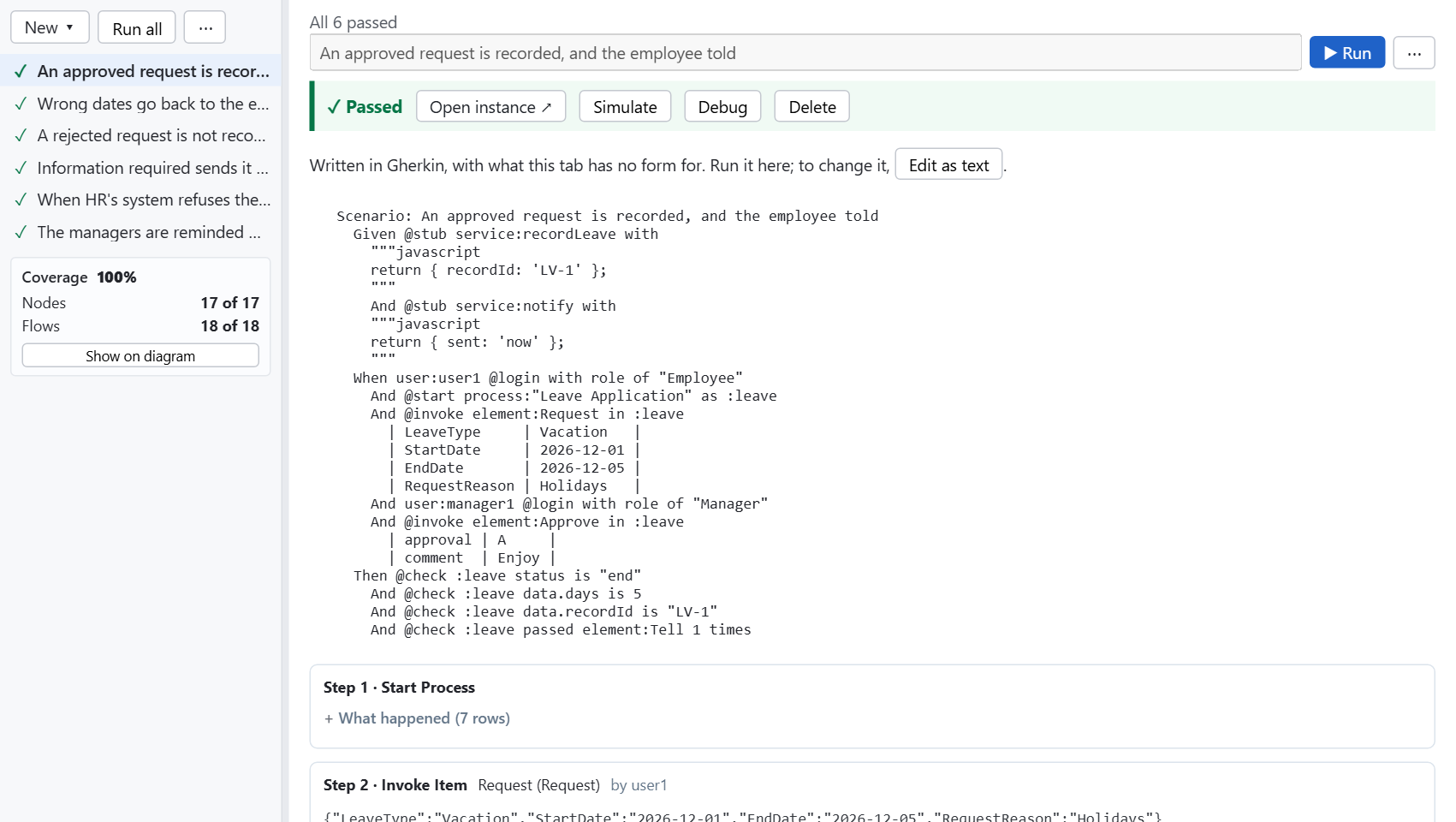
Each scenario starts the process as a user, completes its tasks with data, and checks where it went:
Scenario: An approved request is recorded, and the employee told
  Given @stub service:recordLeave with
    """javascript
    return { recordId: 'LV-1' };
    """
    And @stub service:notifyUsers with
    """javascript
    return { sent: 'now' };
    """
  When user:user1 @login with role of "Employee"
    And @start process:"Leave Application" as :leave
    And @invoke element:Request in :leave
      | LeaveType     | Vacation   |
      | StartDate     | 2026-12-01 |
      | EndDate       | 2026-12-05 |
      | RequestReason | Holidays   |
    And user:manager1 @login with role of "Manager"
    And @invoke element:Approve in :leave
      | approval | A     |
      | comment  | Enjoy |
  Then @check :leave status is "end"
    And @check :leave data.days is 5
    And @check :leave data.recordId is "LV-1"
    And @check :leave passed element:Tell 1 times
@loginsays who acts: the security rules of tutorial 2 apply.@invokecompletes the waiting task, with the table as its form's data.@checkreads the instance: its status, its data, the elements it passed and how often, its items.
Stubs: no real messages, no real records#
A stub replaces a service for this scenario's instances only. notifyUsers sends nothing; recordLeave records
nothing. A stub can also fail on purpose, as HR's system would:
Given @stub service:recordLeave with
  """javascript
  return data.fixed ? { recordId: 'LV-2' } : { bpmnError: 'RecordFailed' };
  """
...
Then @check :leave last element:FixRecord status is "wait"
When user:hr1 @login with role of "HR"
  And @invoke element:FixRecord in :leave
    | fixed | true |
Then @check :leave status is "end"
A timer is stubbed too, so the reminder is tested in a second, not in two days:
Given @stub timer:ReminderTimer with 1 seconds
...
Then @wait :leave passed element:Remind
  And @check :leave last element:Approve status is "wait"
Running them#
- In the editor: Run all in the Test tab, or one scenario's Run. A run is a real instance: under each step, What happened opens to its part of the Rationale, with Add as a check on what the step changed and the step's checks under the rows they check; Open instance shows its page. Edit as text edits the file.
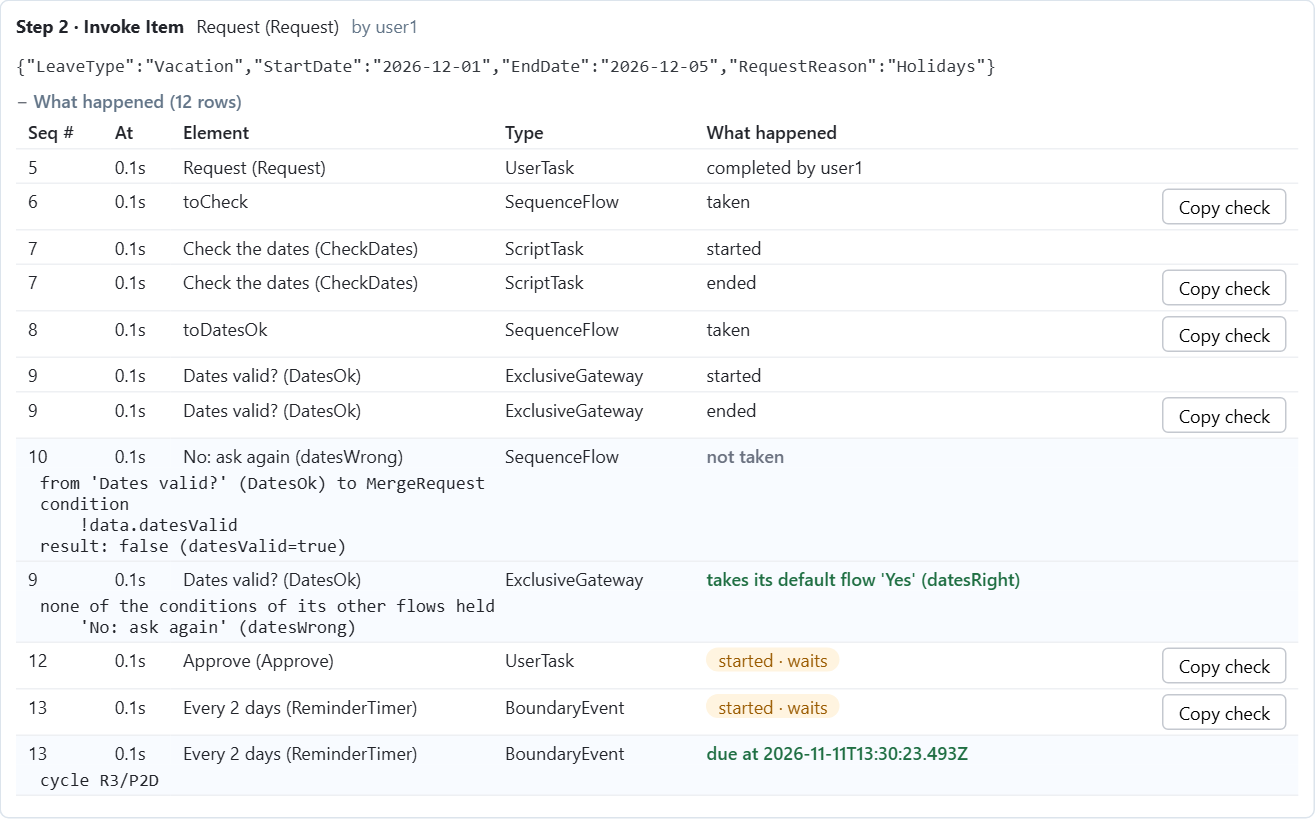 - On the Design dashboard: every model's tests.
- From the command line:
npm test runs every model's tests in memory (no database, no server), and exits 1 if
one fails: what tutorial 9 runs before each release.
Every command and check: Testing and debugging models.
Design choices#
- One scenario per path, named for what it proves.
- Stub what is outside the process: messages, other systems, time.
- Check outcomes, not steps: where it ended, what it kept, what it passed.
Previous: Tutorial 6. Next: Tutorial 8, review before release.