Tutorial 6: Calling services, and failing well#
The requirement: an approved request is recorded in HR's system. If that system refuses it, HR fixes it and it is tried again. Reminders and the outcome reach people.
A service task calls your code#
Record the leave is a service task. Its Service name is recordLeave, a method of your application's
services, in connectors/appServices.ts:
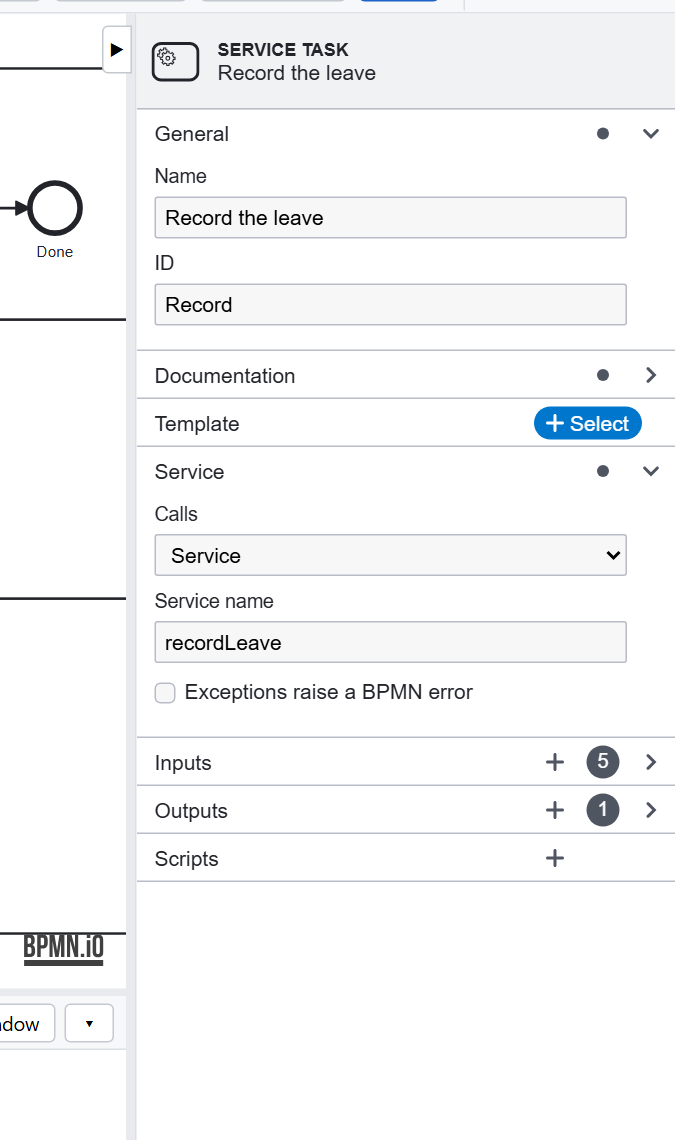
Its Inputs say what it is given (requester, LeaveType, the dates, days, each from the data), and its
Outputs what is kept of the answer (recordId). The service:
async recordLeave({ requester, LeaveType, StartDate, EndDate, days }, context) {
    if (!requester || !(days > 0))
        return { bpmnError: 'RecordFailed' };
    const recordId = `LV-${Date.now()}`;
    console.log(`leave recorded: ${recordId} ...`);       // put your HR system's call here
    return { recordId };
}
Remind the managers and Tell the employee call notifyUsers: whom to tell (users, user names, or groups,
group names: one or a list), a subject and a message. The model decides when and why; the service only sends. In the
sample both services only log what they would do: put your HR system and your email there.
Test is an environment of its own: its own configuration (.env), its own database, and its own services:
connectors/testServices.ts, a class TestServices with the same service names, which answer as the real ones and
send or record nothing. APP_ENV=test in the test environment's .env makes the application use it; production
never loads it. npm test runs as the test environment. After adding a service, run
npm run services so the editor knows it, and offers it under Service name.
A service task can also call a REST API with no code, through a connector: Connect external services.
When the service fails#
A service answering { bpmnError: 'RecordFailed' } raises that BPMN error. Not recorded is a boundary error
event on Record the leave, catching RecordFailed:
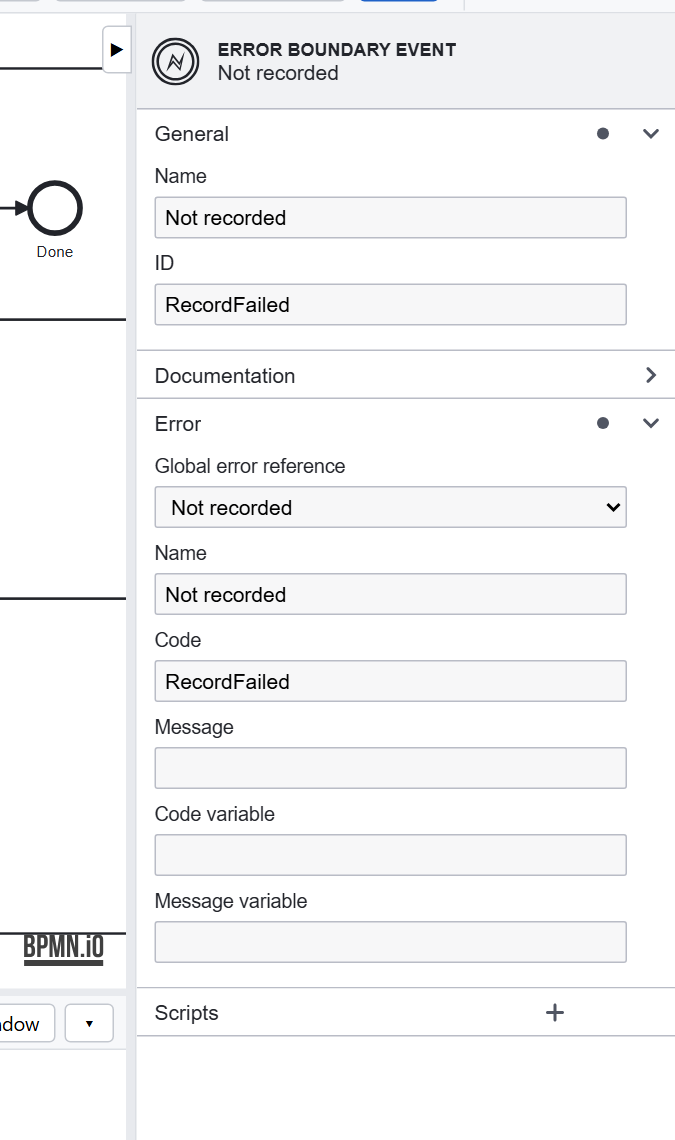
It leads to Fix the record, a task for HR, and back to Record the leave. The instance never stops halfway: either the leave is recorded, or someone in HR has it on their list.
What is not a BPMN error is a failure of the service itself (an exception, a timeout): the item is marked failed, the
instance stops there, and an administrator can Retry it from its instance page. Tick Exceptions raise a BPMN
error on the task to raise those as BPMN errors too, with the exception's code (ETIMEDOUT), and catch them with an
error event of their own: one with no error catches any. See Exceptions as BPMN errors.
Design choices#
- Model the failures the business knows about (a refusal, a missing record) as BPMN errors with a path of their own, and leave unexpected ones to the retry.
- Keep services small and named for the business (
recordLeave, notpost): the model reads as the process. - Keep what a service answers that later steps or people need (
recordId).
Previous: Tutorial 5. Next: Tutorial 7, testing every path.